CMT.AI Research

Road risk reports built on real driving data. Read every finding on the page, or download the PDF.

Latest report

All research

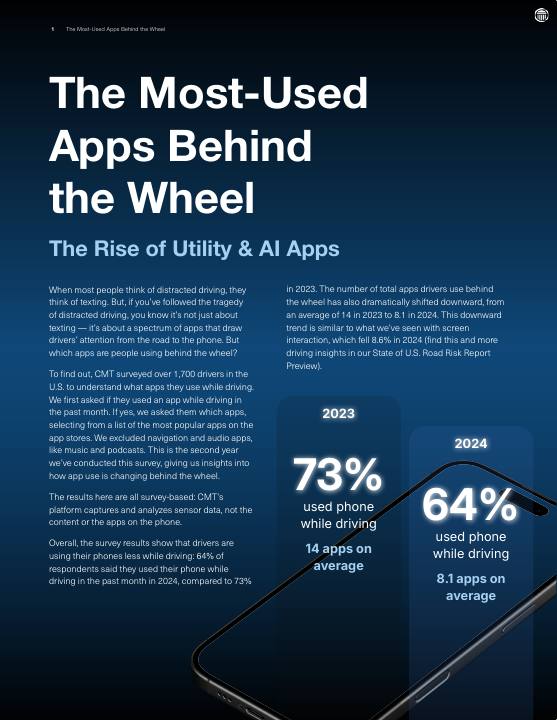
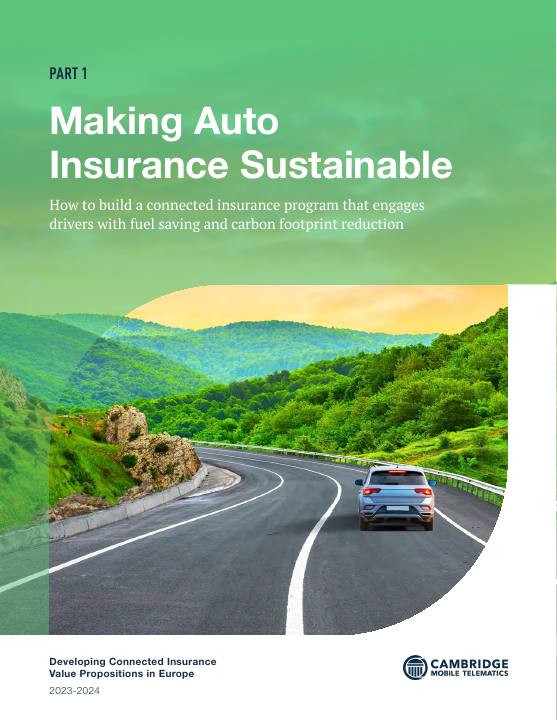
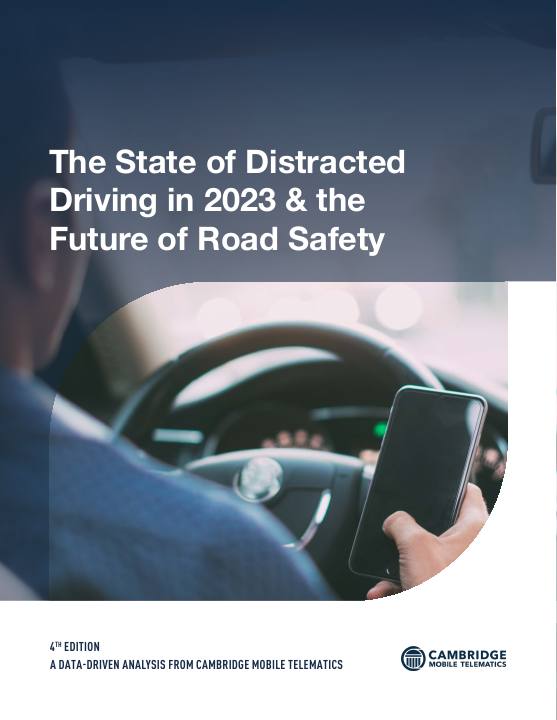
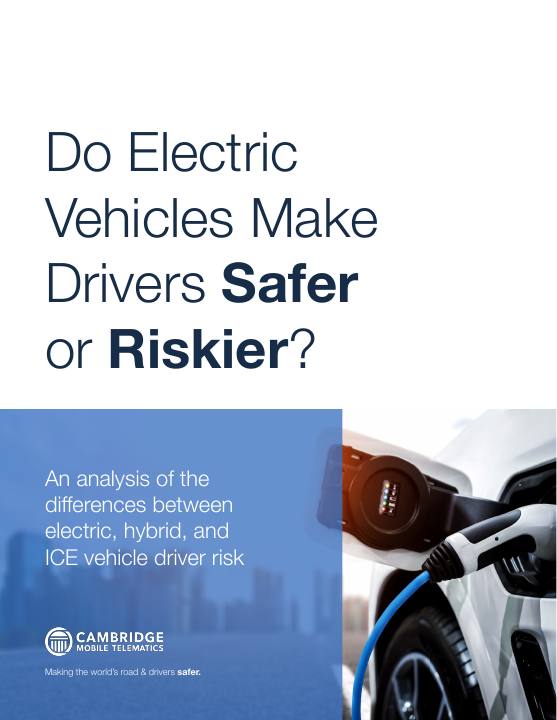
Cover of 2026 Safe Driving Program Sentiment ReportNovember 20262026 Safe Driving Program Sentiment Report84% of drivers would switch insurers for a safe-driving discountCover of The Future of Roadway Safety: Transitioning from Reactive Planning to a Fast LoopApril 2026The Future of Roadway Safety: Transitioning from Reactive Planning to a Fast LoopHighway safety plans use data two or more years old. Telematics measures change within weeksCover of A Data-Driven Action Plan for Safer RoadsSeptember 2025A Data-Driven Action Plan for Safer RoadsTelematics can predict crashes: the most distracted drivers are 240% more likely to crashCover of The Most-Used Apps Behind the WheelJune 2025The Most-Used Apps Behind the WheelGoogle is the most-used app behind the wheel, used by 21.9% of driversCover of The State of US Road Risk, 6th EditionApril 2025The State of US Road Risk, 6th EditionScreen interaction while driving fell 8.6% in 2024, preventing an estimated 105,000 crashesCover of Safe Driving is Sustainable DrivingDecember 2024Safe Driving is Sustainable DrivingDrivers who improve their safety score save 6% on gasoline, or 36.6 gallons a yearCover of The State of US Road Risk in 2024April 2024The State of US Road Risk in 2024Phone screen use while driving fell 4.5% in 2023, to 2 minutes 6 seconds per hourCover of Motivating Safer Driving with TelematicsJanuary 2024Motivating Safer Driving with TelematicsHighly engaged risky drivers cut distraction 20%, hard braking 9% and speeding 27%Cover of Making Auto Insurance SustainableOctober 2023Making Auto Insurance Sustainable78% of European drivers are worried about rising temperatures, and top drivers cut emissions by 30%Cover of The State of Distracted Driving in 2023 & the Future of Road SafetyApril 2023The State of Distracted Driving in 2023 & the Future of Road SafetyDistracted driving rose more than 20% from 2020 to 2022, with phones used on 58% of tripsCover of Do Electric Vehicles Make Drivers Safer or Riskier?July 2022Do Electric Vehicles Make Drivers Safer or Riskier?Tesla drivers have a 48% lower crash rate in their Tesla than in their other vehicle

Academic studies

Peer-reviewed and independent research built on CMT.AI driving data.

Journal placement pending, August 2026Study shows police reports undercount cellphone use before crashesPolice reports miss most cellphone use before crashes. Telematics data linked to nearly 17,000 crashes showed cellphone use was undercounted in police reports by a factor of at least 7.Traffic Injury Prevention, September 2026Predicting cellphone manipulation based on magnitude of speedingSpeeding and phone use go hand in hand. A 5 mph increase in speed was linked to more cellphone manipulation, an effect nearly 4 times as strong on limited-access roads as on primary and collector roads.Journal of Safety Research, June 2026Evaluation of Arizona’s statewide handheld cellphone banArizona’s hands-free law was followed by a real drop in handheld calling. Handheld-call time fell 26% after the law took effect — a reduction telematics data could confirm statistically, though roadside observation alone could not.Journal of Safety Research, June 2024The utility of telematics data for estimating the prevalence of driver handheld cellphone use, 2019–2022CMT’s data lined up closely with NHTSA’s own roadside survey — tracking the same trends year over year, while also capturing conditions NOPUS can’t reach, like overnight hours and higher-speed trips. Nationwide, handheld calls showed up on 3.5% of trips and cellphone motion on a third of all trips.Accident Analysis & Prevention, February 2026A national randomized field experiment testing simulated UBI programsSimulated insurance feedback made drivers safer. A 1,449-driver national trial found that usage-based insurance-style feedback and incentives cut speeding by 11%–13%, hard braking by 16%–21%, and rapid acceleration by 16%–25% relative to a control group.JAMA Network Open, October 2024Handheld cellphone use and risky driving in adolescentsTeen drivers and phones are a risky mix. Handheld phone use was detected in 34.1% of trips by newly licensed teen drivers and was associated with more hard-braking and rapid-acceleration events.PNAS, August 2024A randomized trial of behavioral interventions yielding sustained reductions in distracted drivingGamified feedback and social competition reduced handheld phone use by 20% relative to control — and adding modest financial incentives pushed that reduction to 28%, a change that persisted after the intervention ended.JAMA Network Open, July 2024Feedback and financial incentives for reducing cellphone use while drivingFeedback plus incentives reduced handheld phone use by 15% to 21% relative to a control group, when combining social comparison feedback with financial incentives.Transportation Research Interdisciplinary Perspectives, May 2024Validation of a smartphone telematics algorithm for classifying driver tripsCMT’s driver-classification algorithm was found to be 96.5% accurate overall in an independent field study of the technology used across smartphone telematics apps — correctly identifying 97.5% of actual driver trips as such.Federal Highway Administration, February 2022Comparative effectiveness of alternative smartphone-based nudges to reduce cellphone use while drivingTwo national randomized trials found that reframed, loss-framed incentives combined with feedback cut handheld phone use by up to 25%, in research published by the Federal Highway Administration.Transportation Research Record, 2025Safe driving is sustainable drivingSafer driving is greener driving. An interpretable telematics model found that safe drivers are more than 5% more fuel-efficient than risky drivers — savings that add up to nearly 63 gallons of gas and about $193 per year for a typical SUV.PNAS Nexus, 2022Measuring racial and ethnic disparities in traffic enforcement with large-scale telematics dataResearchers used CMT telematics as an independent benchmark for actual speeding rates and found that, on average, a neighborhood with 75% non-White residents saw about 20% more speeding stops than one with 75% White residents — despite similar underlying speeding rates.ICCV, 2021Inferring high-resolution traffic accident risk maps based on satellite imagery and GPS trajectoriesAI can predict accident risk at 5-meter resolution. A deep-learning model combining GPS trajectories with satellite imagery outperformed the best comparable low-resolution method by nearly 18 percentage points on its accuracy metric — even without historical crash data.