
Road Risk Analysis: Distracted Driving increased 35% during the Boston Marathon
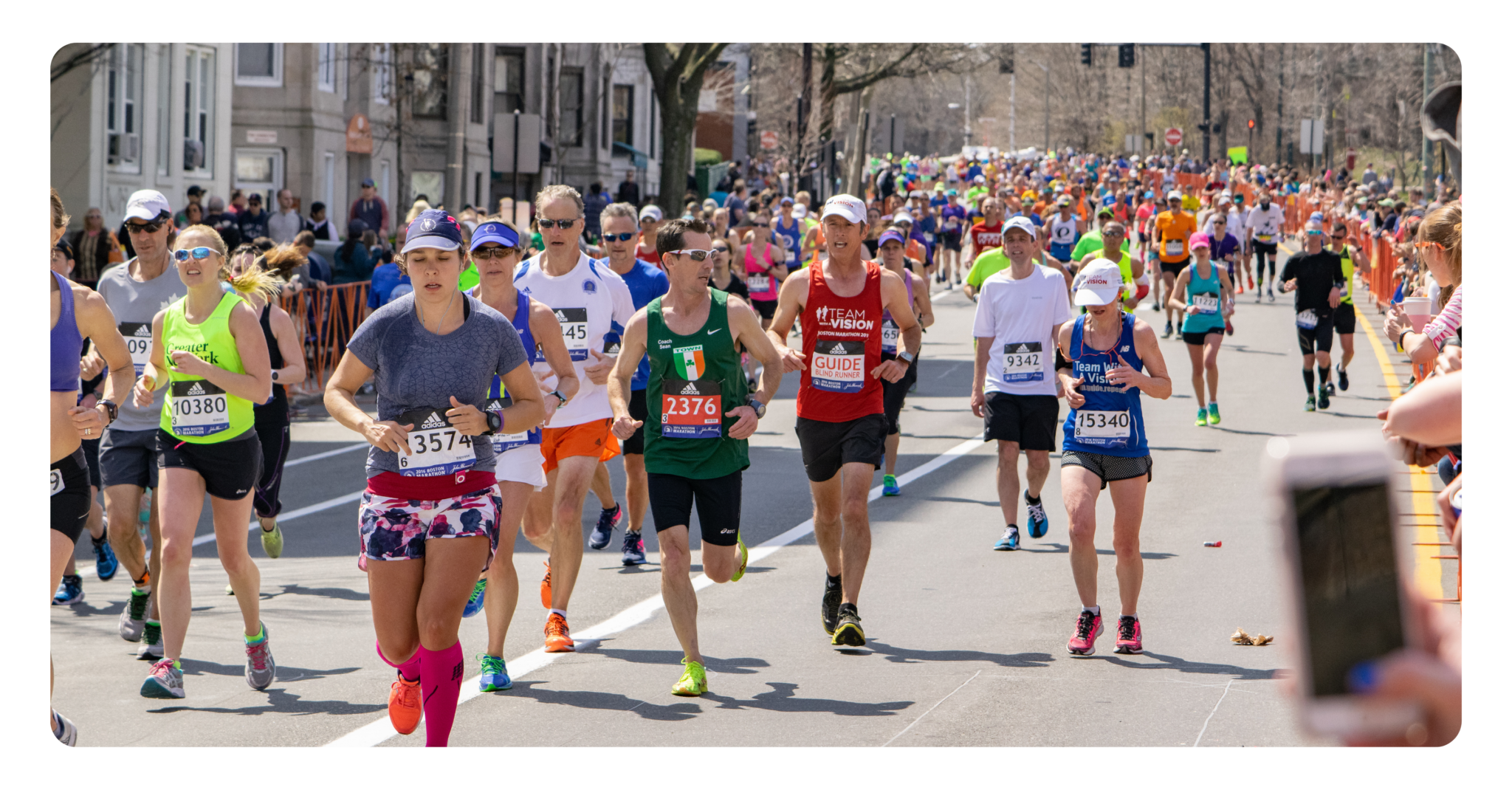
Every April, the Boston Marathon reshapes how people move across Massachusetts for a day. In 2026, more than 30,000 runners and over half a million spectators lined the course, while road closures across eight cities and towns altered traffic along 26 miles of roadway.
The Marathon moves across the region in stages, starting at 9:00 a.m. and ending at 5:30 p.m. Road closures begin early in Hopkinton and progress east into Boston, guiding drivers onto alternate routes over several hours.
To understand how drivers responded to changing road conditions, we analyzed distracted driving trends along the route. Using CMT’s AI Road Safety platform, StreetVision, we measured the percentage of driving with phone motion, a signal of active phone use behind the wheel, comparing Marathon Monday to typical Mondays to track how distraction changed by location and time of day.
Overall, distracted driving increased by 35.4% on surrounding roads throughout the course. It spiked early as closures took effect, stabilized during peak race hours in some locations, and rose again where disruption lasted longest.
Here’s how distraction changed across the course.
Hopkinton and Ashland: distraction up 46% before the starting gun
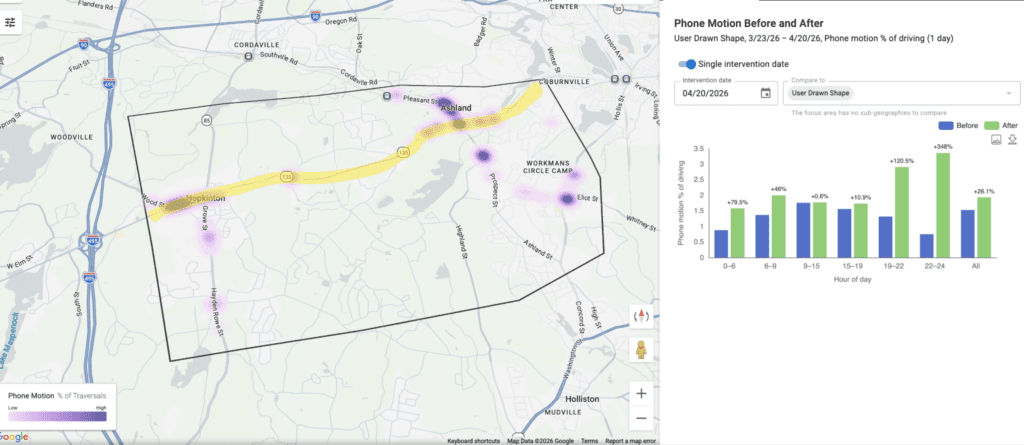
The race began on Main Street in Hopkinton at 9:00 a.m. We analyzed an area extending from Hayden Rowe Street through Cedar Street in Hopkinton and into Pond Street in Ashland. Road closures began at 6:30 a.m., cutting off key connectors to Route 135 and reshaping traffic flow.
Distraction surged before the race. Between 6:00 a.m. and 9:00 a.m., phone motion rose 46%. On a typical Monday, 1.37% of driving involves distraction; on Marathon Monday, that rate rose to 2% as drivers navigated detours and unfamiliar routes.
During the race, from 9:00 a.m. to 3:00 p.m., distraction remained within typical levels. However, post-race, distraction increased by 10.9% as roads returned to normal. Across the full day, distraction in this area rose by 17.3%.
Framingham and Natick: distraction increased 28% ahead of the race
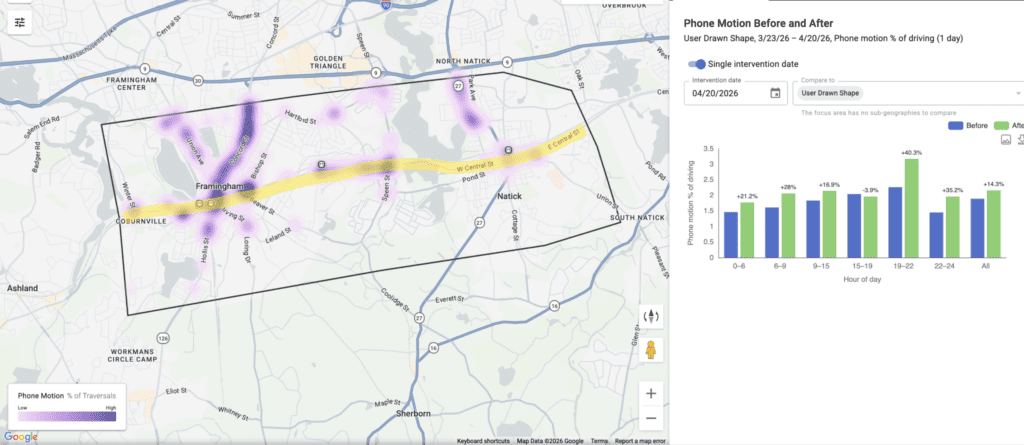
Moving east, we analyzed the stretch from Winter Street in Framingham through Union Street in Natick, where closures along Route 135 lasted from 7:45 a.m. to 2:30 p.m., pushing traffic onto surrounding local roads for much of the day.
Distraction built early, increasing 28% between 6:00 a.m. and 9:00 a.m. as drivers began adjusting routes. Unlike the first region, during peak race hours in Framingham and Natick, phone motion rose 17%, from 1.83% to 2.14%. After roads reopened, distraction stabilized. In total, distraction in this region was up 12.4% for the day.
Wellesley: distraction surged 81% during the race
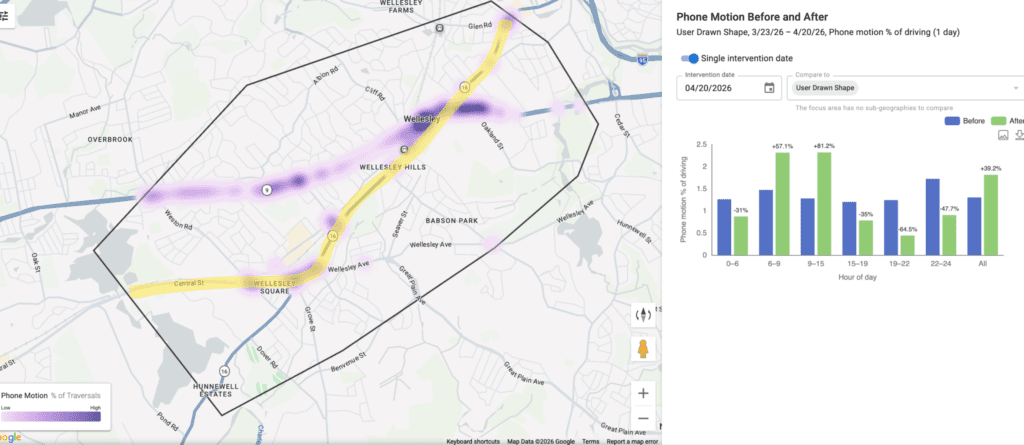
Around the midpoint of the race, the route passed through Wellesley’s town center, entering along Route 135 near Wellesley College. We analyzed the roads between Routes 135 and 16, extending to the intersection of Glen Road. Central roads were closed from 8:30 a.m. through 3:30 p.m., limiting movement through this high-density area.
Before the race and during peak race hours, distraction surged. It increased by 57% in the early morning and by 81% between 9:00 a.m. and 3:00 p.m., rising from 1.28% to 2.32%. Once roads reopened, distraction dropped below usual levels. Across the day, distraction increased 37%.
Newton: distraction increased 31% in the late afternoon
As the course entered Newton and approached Heartbreak Hill, disruption became both broader and longer-lasting. Along Route 16 and Commonwealth Avenue, extending toward the Boston College area, dozens of roads were closed from 8:00 a.m. through 7:00 p.m., limiting through-traffic for most of the day.
Distraction was elevated ahead of the race, up 72%. During the main race window, distraction remained close to typical levels. However, in the late afternoon and early evening, as roads remained closed, distraction increased by 31.2%. Overall, distraction was up 29.7% throughout the day.
Brookline: distraction over 139% elevated as roads remained closed
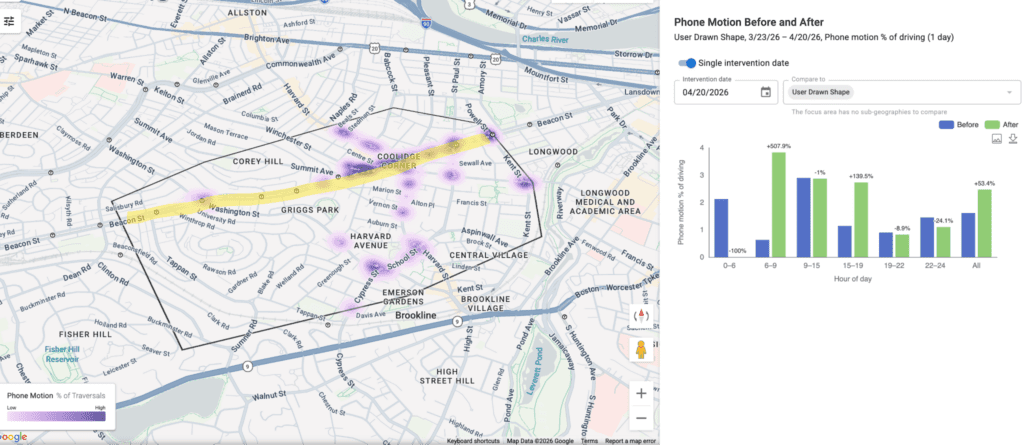
In Brookline, we analyzed roads along Beacon Street from Tappan Street to Kent Street. Road closures ran from 8:00 a.m. to 6:00 p.m., restricting a major commuter corridor into Boston.
Early in the day, Brookline saw the largest spike in distraction in this analysis. Between 6:00 a.m. and 9:00 a.m., phone motion increased a staggering 508%, rising from 0.63% to 3.83% as closures took effect.
During the race, distraction returned to typical levels. But later in the day, as roads remained closed and later reopened, distraction rose again — up 139%, from 1.14% to 2.73%. For the day, distraction in Brookline more than doubled, up 102%.
Boston: distraction up 26% during peak race hours
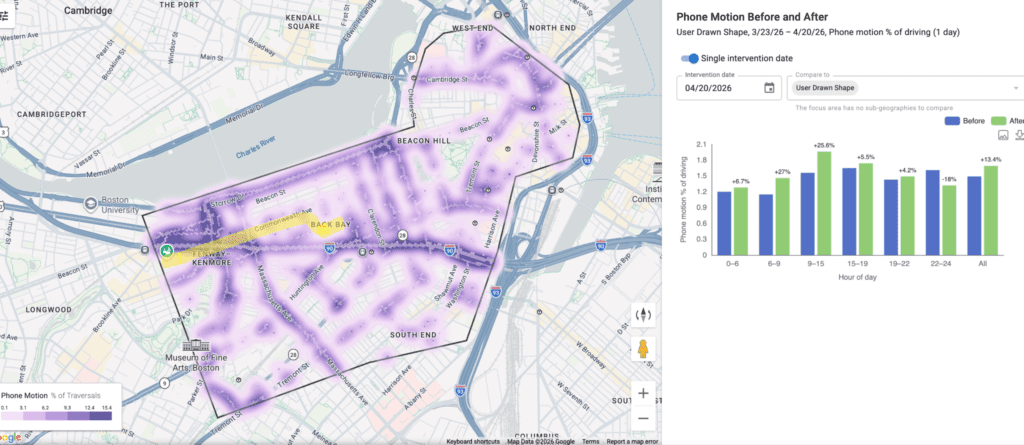
Road closures spanned throughout Boston. We analyzed downtown Boston from Fenway through the South End, Beacon Hill, and the West End, where crowds concentrated near the finish line along Commonwealth Avenue.
Before the race, distraction was up 27%. During peak race hours, it increased by 26%. In the late afternoon, as conditions began to ease, distraction decreased, but remained elevated by 5%. For the day, distraction in Boston increased 18.4%.
Distraction rises throughout Marathon Monday
Across the six regions analyzed, all saw a significant increase in the early morning as road closures took effect, with distraction rising 87% during this period. During peak race hours, increases were more mixed, with distraction rising in three of the six regions — up 15% across the course.
In the three regions where roads reopened earlier in the afternoon, distraction generally returned to typical levels after the race passed. In contrast, in the three regions where road closures remained in place into the evening, distraction increased again — up 20.5% across all regions during this period.
While the impact varies by location and time of day, drivers across Massachusetts were more distracted throughout Marathon Monday — likely as they navigated unfamiliar routes and adjusted to changing conditions.