
How March Madness Impacts Distracted Driving

March Madness creates a surge of buzz across the country, fueled by unpredictable, can’t-miss moments. For drivers, does that buzz carry over to their phones behind the wheel?
We analyzed distraction trends among drivers in host cities during the first four rounds of the NCAA Men’s Basketball Tournament, focusing on areas surrounding the arenas where games were played. We compared phone tapping events per 100 miles during game windows to similar days in surrounding weeks.
Distraction in many of the host cities spiked significantly during the first round, when games were spread across the entire day. As the tournament shifted to smaller game windows in the second round, those increases became more concentrated. Beyond the first weekend, patterns were less uniform, with cities seeing varying levels of impact.
Round 1: All-Day Games Drive the Biggest Spikes
The first round took place across eight cities: Buffalo, Greenville, Oklahoma City, Portland, Philadelphia, San Diego, and St. Louis. With four games in each arena, hoop action spanned nearly the entire day.
Across these cities, distraction generally increased, but the magnitude and timing varied.
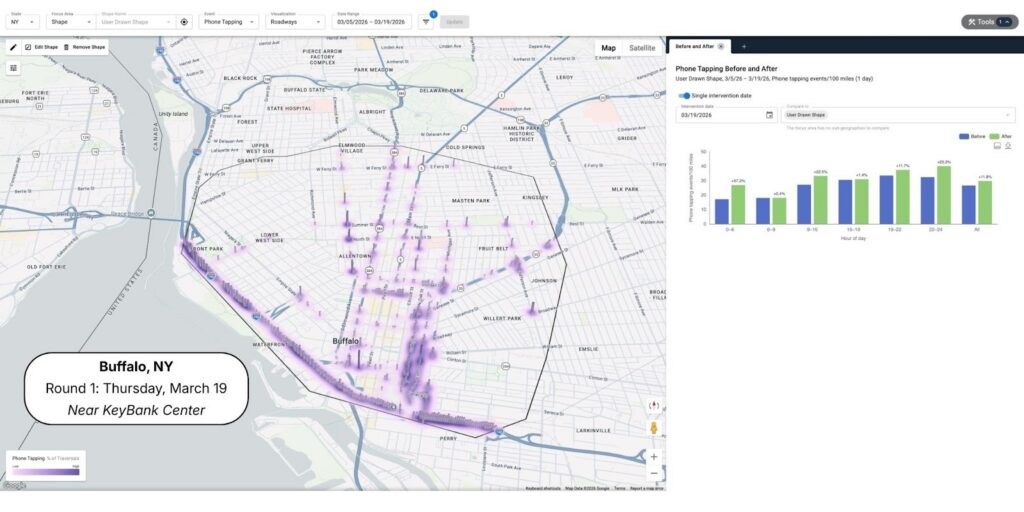
Buffalo and St. Louis saw the largest overall increases. In Buffalo, distraction rose by 14.6%, increasing from 30.9 to 35.4 phone tapping events per 100 miles. The biggest spike came during the late game window between 9:00 p.m. and 11:00 p.m., when distraction jumped by 23.3%. During that time, Michigan vs. Howard was wrapping up while Saint Louis vs. Georgia was tipping off, creating sustained, high-attention moments.
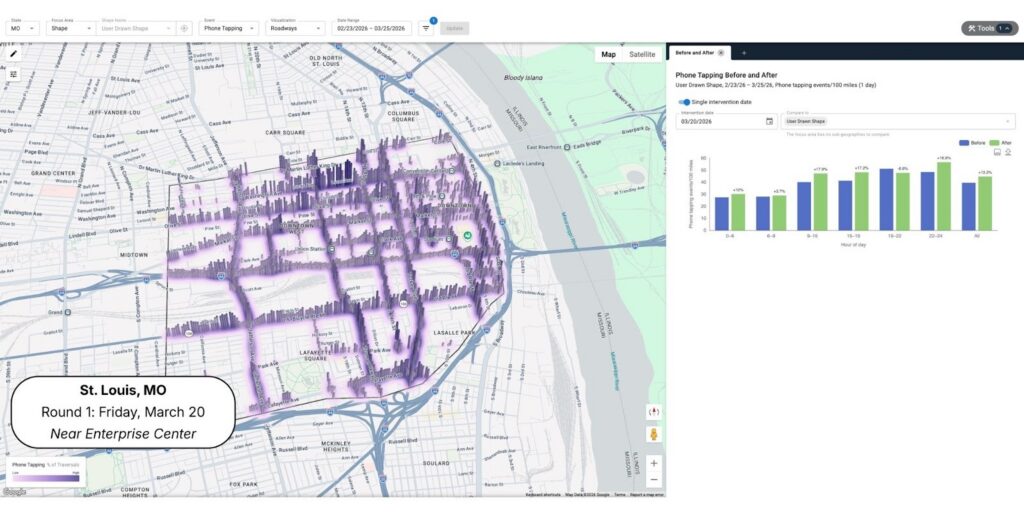
St. Louis saw a similar increase of 10.5%, rising from 45.2 to 50 tapping events. But unlike Buffalo, the biggest spike came earlier in the day. Distraction increased by 17.9% between 9:00 a.m. and 3:00 p.m., aligning with one of the earliest tip-offs of the tournament, when Santa Clara faced Kentucky in the early afternoon.
Other cities saw more modest increases. Portland experienced a 5.3% overall rise, with a 15.3% spike during the evening game window. Oklahoma City and Greenville both saw smaller increases in the 3–4% range, with Oklahoma City showing a late-night bump of 11% between 9:00 p.m. and 11:00 p.m.
Overall, six of the eight cities saw increases in distraction during game windows, but the timing of those spikes varied significantly. Some aligned with prime-time games, while others occurred with the early games.
These increases likely reflect a mix of behaviors, including drivers checking scores, increased traffic near arenas, and higher activity in downtown areas.
Round 2: Fewer Games, More Concentrated Windows
In the second round, the structure of the tournament shifts. Each city hosted only two games, narrowing activity into shorter windows. Distraction was no longer spread across the day, with most of the increase occurring in the evening.
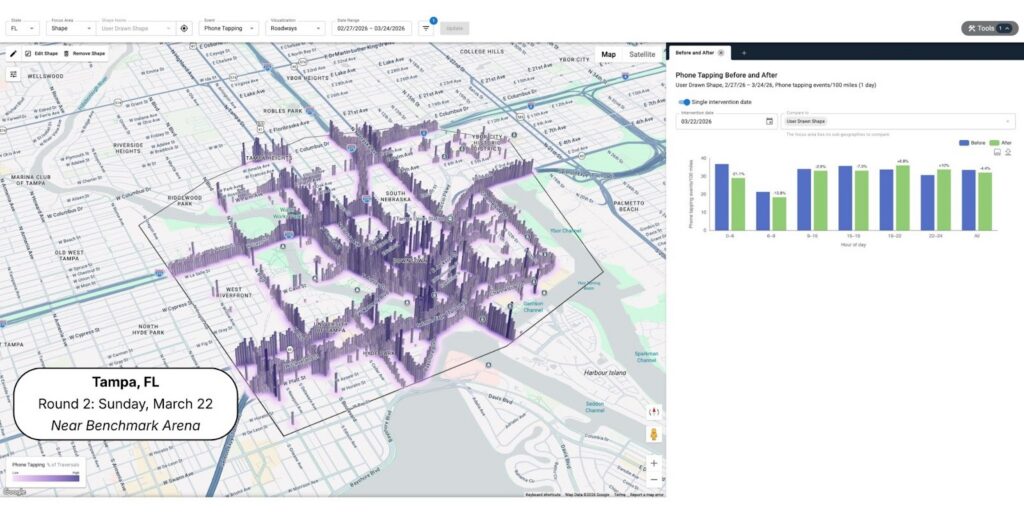
Tampa and Philadelphia saw some of the most pronounced increases. In Tampa, distraction rose by 8.3% between 7:00 PM and 11:00 PM. Philadelphia saw a 6.8% overall increase during game time, with a 15.8% spike between 9:00 PM and 11:00 PM. Greenville experienced one of the most dramatic increases of the round, with distraction rising by 33.3% during the late evening window.
Across Round 2, six of the eight cities still saw increases, largely concentrated at night.
Sweet 16 and Elite 8: Less Impact
The Sweet 16 and Elite 8 rounds took place in Houston, San Jose, Chicago, and Washington, D.C. With cities hosting two games in the Sweet 16 and one in the Elite 8. The impact on distraction was less significant.
Houston was the only city to see a notable increase during the Sweet 16, with distraction rising by 6.8%, including a 19.2% spike during the late-night window when the hometown Houston Cougars faced Illinois.
During the Elite 8, changes were even smaller. Chicago and Washington, D.C. were the only cities to see increases in distraction, rising in 3–4% range.
Final Buzzer
March Madness may be unpredictable on the court, but its impact on driver behavior is more consistent. Distraction rises as games tip off and attention shifts away from the road. That effect is most pronounced in the first round, when games run throughout the day, creating sustained increases across host cities.