
When are UK Roads Most Risky During Christmas Time?
The holiday period is consistently linked to a significant spike in risky driving behaviours across the UK. With more than 3,100 car crashes occurring between December 17 and 30 in 2024, we set out to understand if road risk rises during the holiday period. CMT’s latest analysis, based on three years of aggregated driving behaviour, demonstrates that poor driving standards are not random but follow a predictable, escalating pattern directly coinciding with the Christmas run-up and the days following.
We discovered a predictable start to the driving risk cycle with the increase in hazardous behaviour beginning the last few weekends before Christmas. Specifically, it starts the last Friday before Christmas for phone distraction and on the last Saturday for speeding.
The surge in speeding has worsened by 184% in the last 3 years
Speeding sees the biggest increase during the holiday season. Since 2022, the average increase in speeding has worsened by 184%. This means the gap between typical driving behaviour and risky driving during the holiday period is widening, making the Christmas rush an increasingly dangerous time on British roads. The highest peak for speeding behaviour is consistently recorded on Christmas Day, often as drivers hurry between family engagements.
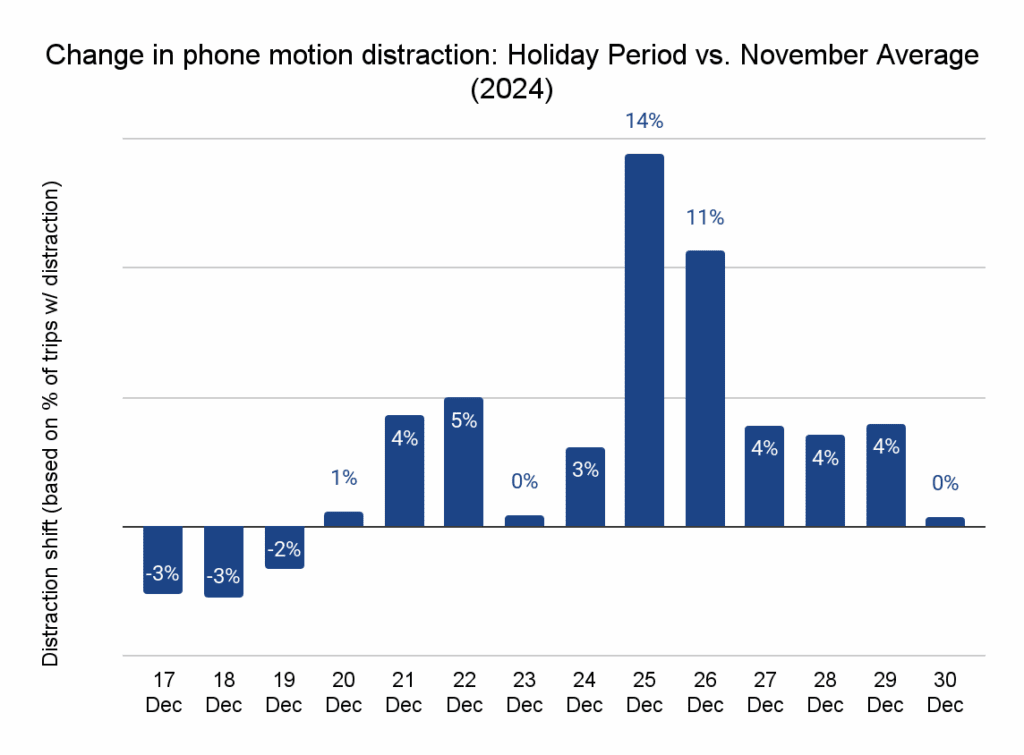
Throughout the season, there is an annually recurring change in behaviour in regards to phone distraction. This could be related to the elevated need to check shopping deliveries, tracking parcels, navigating, or other activities. Regardless, the result is much more severe distraction risks behind the wheel.
- The share of trips recording phone screen interaction, when drivers tap on the screen, rises by up to 16% during the holidays, with the highest spike occurring on Christmas Day.
- The share of trips with phone motion distraction, when drivers handle the phone, also sees a noticeable increase, rising by as much as 14%.
These metrics highlight the intensified cognitive load experienced by drivers, who are often splitting their attention between essential driving tasks and device usage at a time of increased traffic, longer drives in the dark and potentially worse weather conditions.
Hard Braking has deteriorated since 2022
Let’s turn now to the share of trips with hard braking events. This serves as a crucial measure of hazard perception, indicating that drivers are frequently following too closely or reacting late to events. Historically, the holiday season registered fewer hard braking events than the November baseline, suggesting a small margin of safety, likely due to slower average speeds.
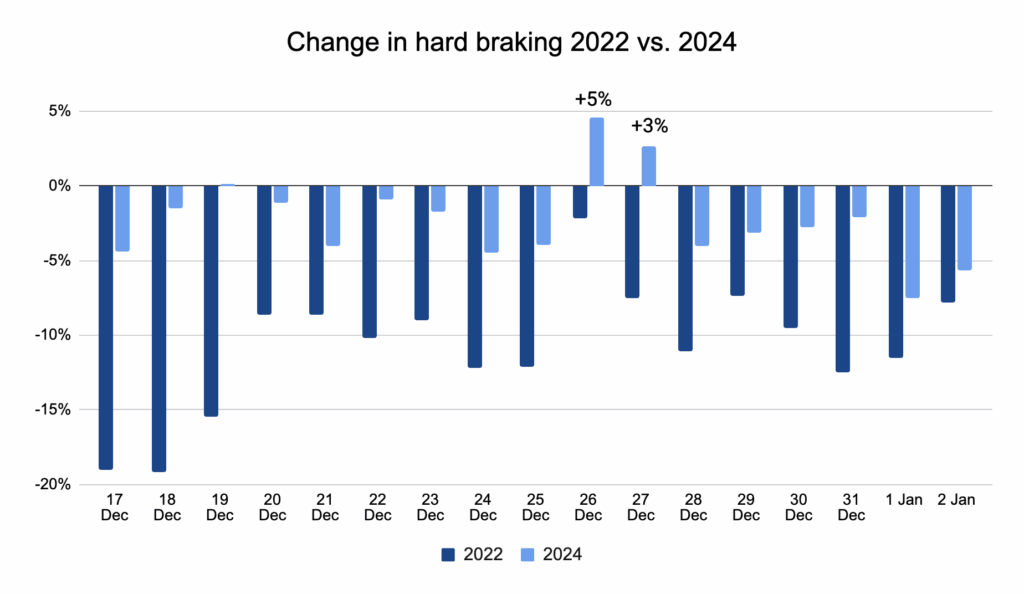
However, CMT’s 2024 data reveals that this narrow safety margin is rapidly deteriorating. When comparing Christmas Day (25th December) over the last three years, the difference between the November average and the Christmas Day rate has reduced significantly.
Crucially, for the first time in 2024, CMT is observing isolated days during the holiday season where the frequency of hard braking exceeds the November average. This suggests that drivers are now being forced into highly reactive, emergency braking maneuvers more regularly than usual, perhaps coinciding with the increase in speeding during the season.
These consistent data points confirm that the Christmas period is characterised by significantly increased risk, demanding serious consideration and mitigation strategies from UK insurers, fleet managers, and road safety organisations.
What does this mean for drivers?
Fridays and Saturdays deserve special attention: plan earlier, slow down near retail zones, and use do-not-disturb modes by default. Christmas Day itself concentrates risk: lighter traffic tempts higher speeds, while long, unfamiliar journeys and in-car messaging drive distraction.