
Here’s What Drivers Actually Do When They Encounter Speed Cameras
Speed cameras don’t suffer from a lack of opinions.
Some call them essential safety tools. Others call them revenue machines. Critics argue they create “compliance at a pole.” Drivers slow down for the camera. Then speed right back up.
But for public agencies, the real question isn’t philosophical. It’s practical:
Do speed cameras change driver behavior in a measurable, lasting way?
To answer that, we analyzed real-world driving patterns in Kenmore, Washington using anonymized telematics-derived analytics from CMT’s Road Safety Platform, StreetVision. Instead of debating theory, we looked at what drivers actually did before and after enforcement changed.
The Setting: A School Zone With Clear Signals
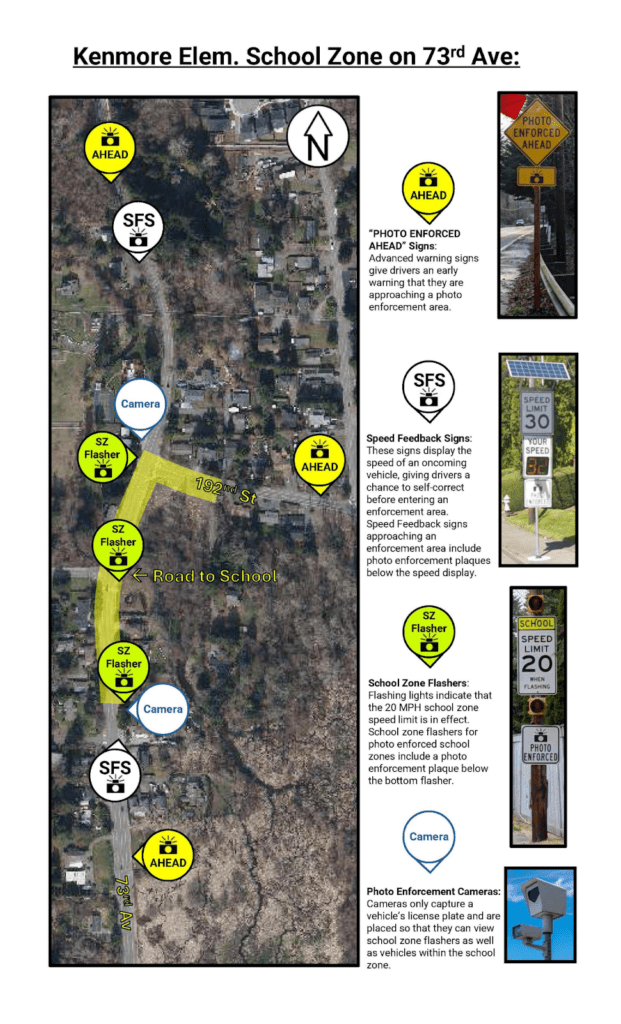
Along 73rd Ave NE near Kenmore Elementary, drivers encounter:
- “Photo enforced ahead” signs
- Speed feedback signs
- Flashing lights when the 20 mph school zone is active
During school hours, the limit drops to 20 mph. At other times, it returns to 30 mph. Drivers exceeding the limit by 6 mph or more are cited.
Importantly, the corridor gives drivers multiple cues before they reach the camera. That makes it a useful case study: behavior here isn’t shaped by surprise, it’s shaped by awareness and enforcement.
What StreetVision Shows at the Road Level
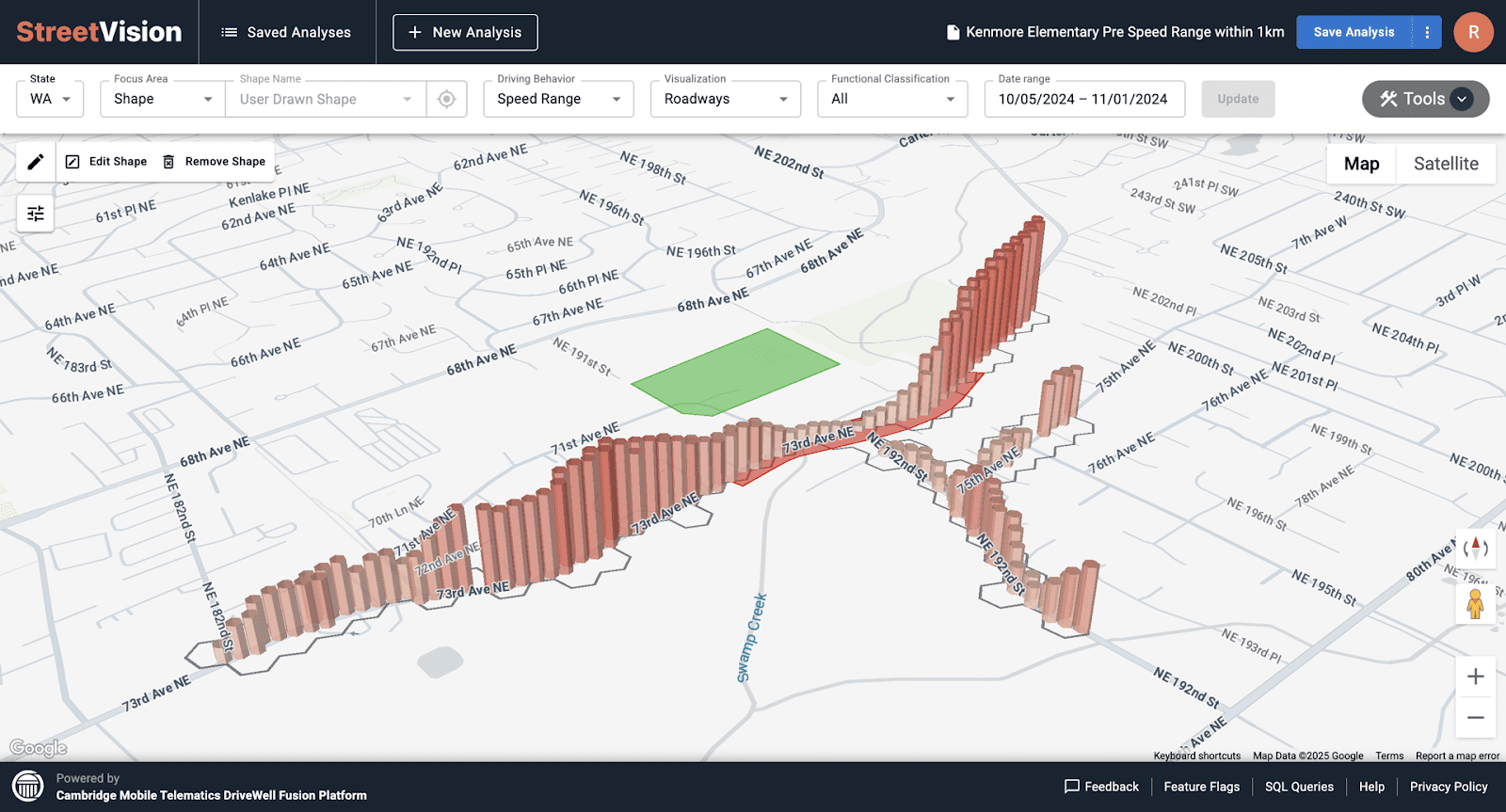
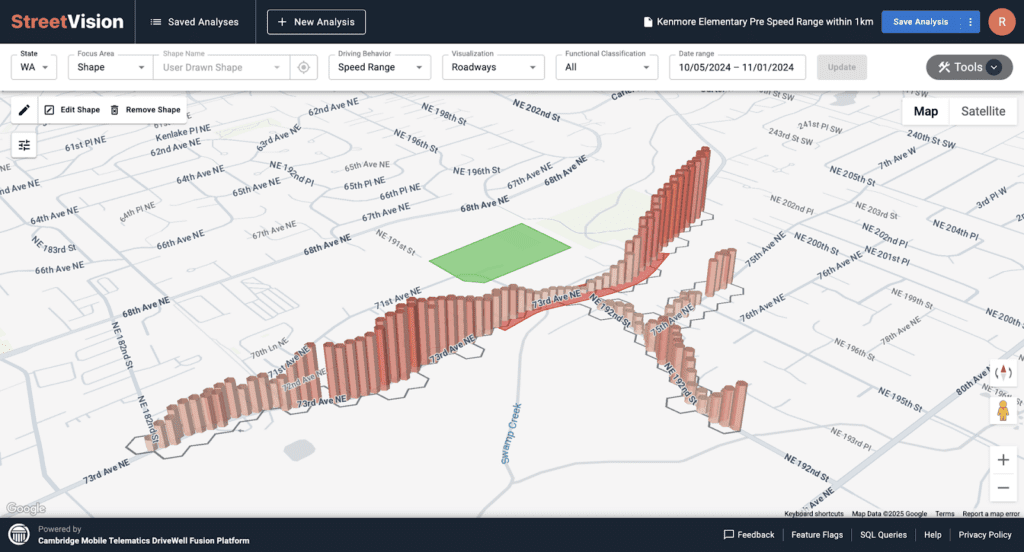
Using StreetVision, we visualized speeds along 73rd Ave NE and surrounding streets.
At a corridor view, speeds clearly drop inside the school zone. But that alone doesn’t prove enforcement is the driver. Some motorists may slow out of caution. Others may encounter turning vehicles.
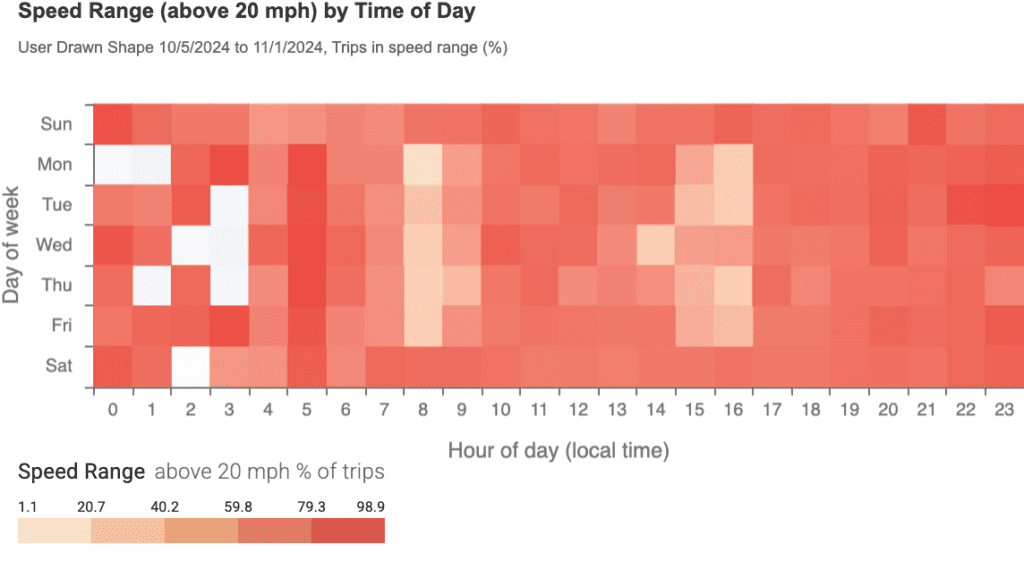
To dig deeper, we examined behavior by time of day.
StreetVision’s heat map analysis shows a sharp decline in speeding exactly when school zone flashers activate — around 8am, 4pm, and early-release Wednesdays. In October 2024, only about 30% of trips exceeded 20 mph during active school zone hours. Outside those windows, speeds increased again.
Drivers were responding. But to isolate speed cameras as the driver, we needed a policy change.
A Natural Experiment: Expanding to 24/7 Enforcement
Since 2023, cameras enforced speed limits only during active school zone hours.
On November 2, 2025, enforcement expanded to 24/7. Drivers exceeding 30 mph outside school hours would now be cited. For 60 days, violations resulted in warnings only, and the change was publicly communicated.
From an evaluation perspective, this was ideal:
- Infrastructure remained unchanged.
- Drivers were already familiar with signage.
- Only enforcement policy shifted.
Using StreetVision’s weekly trend analytics, we compared behavior before and after the change.
The Result: A Measurable, Sustained Reduction
Within two weeks of expanded enforcement:
- Speeds above 30 mph dropped by 7 percentage points — a 30% relative reduction.
- Speeds above 35 mph fell by 39%.
There was a brief spike during winter break, when the school zone was inactive. Once school resumed, speeds declined again.
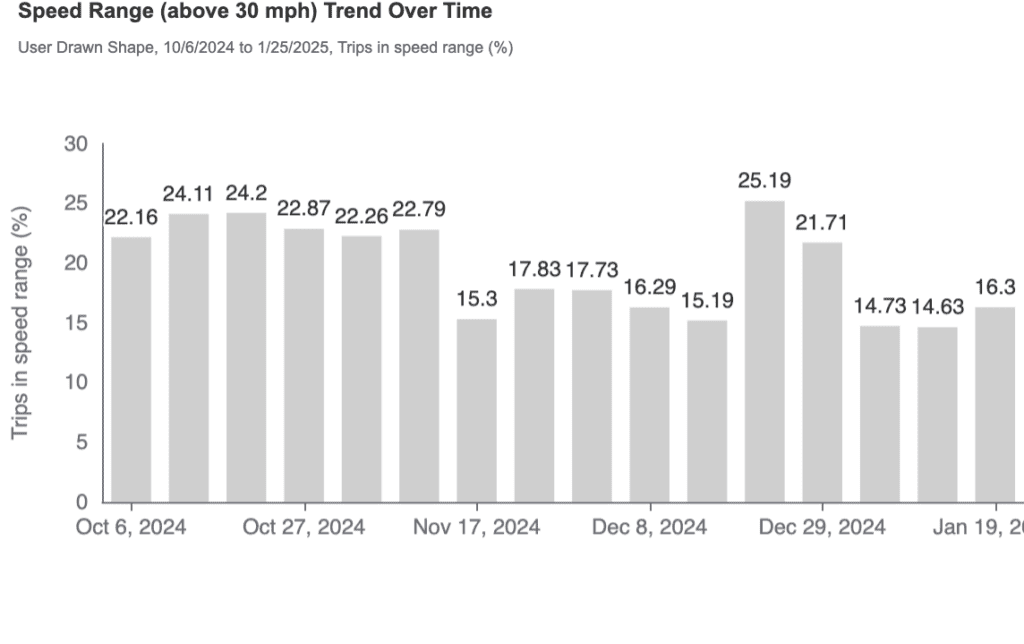
The timing indicates speed camera enforcement, not random fluctuation or some drivers being cautious, drove the change.
What About Unintended Consequences?
One common concern is drivers might brake abruptly when approaching cameras, introducing new safety risks.
Using StreetVision’s hard braking analytics, we tested that assumption.
We found no significant increase in hard braking events after enforcement expanded. Drivers slowed, but not erratically.
For agencies evaluating tradeoffs, that distinction matters.
Why This Matters for Safe System and Vision Zero Strategies
The Safe System approach is built on a simple premise: human mistakes are inevitable, but deaths and serious injuries are not.
Speed plays a central role in crash severity, particularly for vulnerable road users. Lower speeds reduce both crash likelihood and injury severity.
This case study shows:
- Enforcement policy changes can shift behavior quickly
- Effects can be measured within weeks
- Impact can be validated at the road-segment level
- Adjustments can be made based on evidence, not assumptions
For Vision Zero and Safe System leaders, that capability is powerful.
Instead of waiting years for crash trends to emerge, agencies can use platforms like StreetVision to:
- Monitor speeding in high-risk corridors
- Evaluate pre- and post-policy changes
- Detect spillover or displacement effects
- Communicate outcomes transparently
That shifts the conversation from “Do cameras feel effective?” to “Are we reducing risk where it matters most?”
Moving the Debate From Opinion to Evidence
Speed cameras will likely always generate debate. That’s healthy in public policy.
But debates are more productive when grounded in measurable behavior.
In Kenmore, expanding enforcement led to significant and sustained reductions in speeding inside a school zone. Without introducing new observable risk behaviors.
For agencies committed to protecting vulnerable road users and delivering on Vision Zero commitments, that’s not just interesting, It’s actionable.